What Is a THC Drink? A Guide to Hemp-Derived THC Beverages
You’ve probably seen them by now. THC seltzers at the liquor store. THC sodas popping up at barbecues. Someone at brunch pulling out a can you don’t recognize and saying “it’s like a drink but with weed.” Which doesn’t really clear things up.
The THC beverage category has gotten big, fast. And with that growth comes a lot of confusion about what these drinks actually are, how they work, whether they’re legal, and why anyone would choose one over a beer or a glass of wine.
We make THC-infused wine, so we’re obviously biased. But we also know this category well enough to give you a straight answer on all of it.
So what exactly is a THC drink?
A THC drink is any beverage infused with tetrahydrocannabinol, the compound found in cannabis and hemp that produces a relaxing, mood-altering effect. The THC used in most beverages sold online and in stores is hemp-derived Delta-9 THC, which is federally legal under the 2018 Farm Bill as long as the product contains less than 0.3% Delta-9 THC by dry weight.
That last part matters. The “by dry weight” calculation is why a 12-ounce drink can legally contain 5mg or even 10mg of THC and still comply with federal law. The liquid weight of the beverage means even a noticeable dose of THC falls well under the 0.3% threshold.
THC drinks come in a lot of formats: seltzers, sodas, tonics, teas, mocktails, drink mixers, and wine. Most contain somewhere between 2.5mg and 10mg of THC per serving. Some are designed to feel like a light beer. Others are meant to replace a cocktail. And some, like ours, are built to feel like an actual glass of wine because they started as one.
How do THC drinks feel?
Different from alcohol, but not as different as you might expect.
Most people describe the effect as a gentle loosening. A calm that settles in without the heaviness or the mental fog that alcohol brings. You stay present. You stay sharp. You just feel a little more relaxed.
The onset is typically 15 to 30 minutes, which is faster than a traditional edible (like a gummy) but slower than smoking or vaping. That timing works in your favor because it matches the natural pace of drinking. You pour a glass, sip it, and the effect builds gradually rather than hitting you all at once.
Duration is usually about two hours. And the morning after? Nothing. No headache, no nausea, no regret spiral about what you said at 11pm. That’s the part that converts people.
THC wine vs. THC seltzers vs. other THC beverages
Not all THC drinks are trying to do the same thing, and the differences matter more than most roundup articles will tell you.
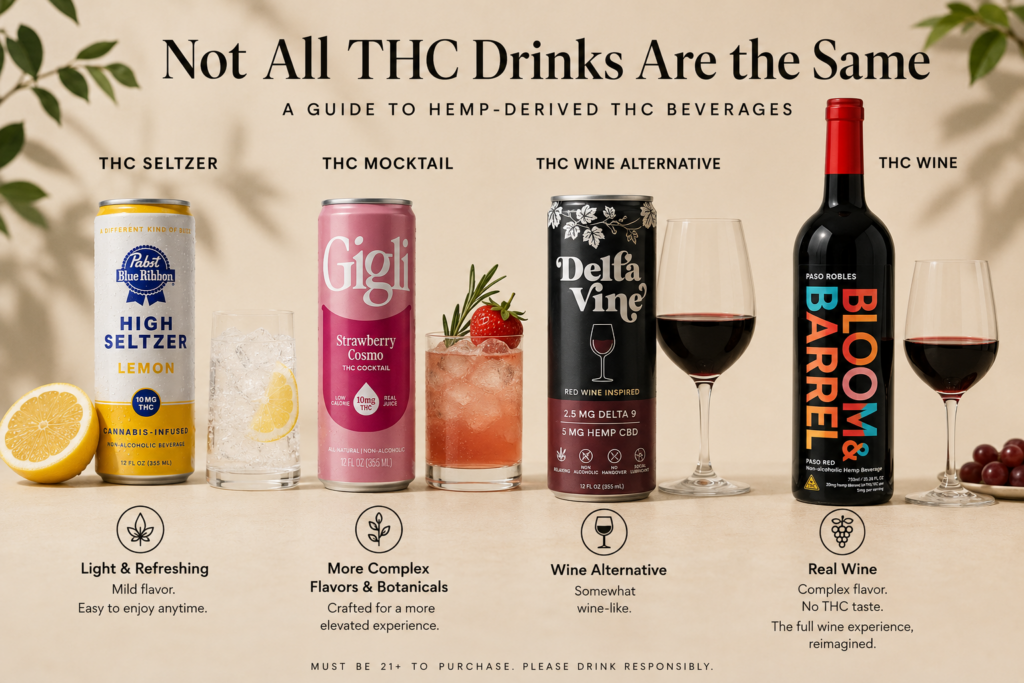
THC seltzers and sodas are the most common format. They’re light, carbonated, low calorie, and easy to grab at a party. If you’re looking for something casual that feels like cracking open a can, these work well. The tradeoff is that most of them don’t taste like much beyond flavored sparkling water. They’re functional, not experiential.
THC tonics and mocktails try to replicate the complexity of a cocktail. Some of them get close. They tend to use adaptogens, botanicals, or citrus to build flavor layers. These are the ones you’ll see at the trendy bar that has a “cannabis cocktail menu.”
THC wine is a different animal entirely. Bloom & Barrel starts as real wine made from grapes grown in Paso Robles, California. The wine goes through traditional winemaking before the alcohol is gently removed and a precise dose of hemp-derived THC is added. Each glass contains 4mg of THC and 30 calories. You get the body, the aroma, the tannins or the acidity you expect from a real wine, plus a calm buzz that replaces the alcohol without trying to imitate it.
The distinction matters because the ritual matters. Pouring a glass of wine at the end of the day feels different from cracking a seltzer. Sitting down to dinner with a bottle on the table creates a different kind of evening than passing around cans. If the ritual of wine is part of what you enjoy about drinking, a THC seltzer isn’t going to scratch that itch, no matter how good the flavor is.
Are THC drinks legal?
At the federal level, yes. Hemp-derived Delta-9 THC products that contain less than 0.3% THC by dry weight are legal under the 2018 Farm Bill. That’s the law that moved hemp out of the Controlled Substances Act and created the legal framework for the entire hemp-derived THC market.
State laws are where it gets complicated. Some states have embraced hemp-derived THC beverages and built regulatory frameworks for them. Others have restricted or banned them outright. And the landscape is changing quickly. Several states tightened regulations through 2024 and 2025, and more legislation is expected through the rest of 2026.
A few things to know about the current regulatory situation:
The FDA has not formally approved hemp-derived THC as a food additive, and they’ve issued warning letters to companies making health claims. That doesn’t mean the products are illegal, it means the regulatory framework is still catching up to the market.
New federal rules expected to take effect in late 2026 could change the THC calculation from a percentage-of-dry-weight standard to a milligram-per-container cap. If that happens, it would reshape the entire category.
We only ship to states where hemp-derived THC beverages are currently permitted. If you want to understand the specific laws in your state, the U.S. Hemp Roundtable tracks state-by-state legislation and provides resources for consumers and businesses navigating this space. They’re the leading advocacy organization for responsible hemp policy, and Bloom & Barrel is a supporter of their work.
What should you look for in a THC drink?
The category has grown fast, and not every brand has kept up on quality. A few things worth checking before you buy:
Third-party lab testing. Any reputable THC beverage brand should provide Certificates of Analysis (COAs) from an independent lab confirming the THC content and checking for contaminants. If a brand can’t show you a COA, skip it.
Clear dosage information. You should know exactly how many milligrams of THC are in each serving. Vague language like “proprietary blend” or “cannabis extract” without milligram counts is a red flag.
Hemp-derived vs. marijuana-derived. If you’re buying online or outside a licensed dispensary, the product should be hemp-derived. Marijuana-derived THC products are only legal through state-licensed dispensaries in states with recreational cannabis programs.
Taste that actually works. This one’s subjective, but it matters. The best THC drinks are ones you’d enjoy even without the THC. If the only reason to drink it is the effect, you’ll stop buying it.
Why we built a THC wine instead of another seltzer
When we started Bloom & Barrel, the THC beverage market was already full of seltzers and sodas. What it didn’t have was a real wine. Not a wine-flavored drink, not a grape-infused seltzer, but actual wine made from actual grapes by actual winemakers in one of California’s best wine regions.
We thought there was a gap between the sober-curious consumer who wanted to cut back on alcohol and the wellness-oriented shopper looking for a functional beverage. Both of those people might grab a THC seltzer on a Saturday afternoon. But when Friday night dinner comes around and you want something that feels like opening a bottle of wine, the seltzer doesn’t work anymore.
That’s the space Bloom & Barrel fills. Our Paso Red and Chardonnay have won three awards in 2026 from TEXSOM and the High Spirits Awards. The Chardonnay took Platinum. The judges evaluated them as wines and found them worthy. We think that says more than any marketing copy we could write.
Each glass is 4mg of THC, 30 calories, non-alcoholic, and made from Paso Robles grapes. If you’ve been curious about THC drinks but haven’t found one that fits the way you actually like to drink, this might be the one worth trying.